




The 3 Vs of big data – Volume, Velocity, and Variety – form the foundation for handling massive datasets in today’s digital world. These characteristics explain why traditional tools like relational databases often fall short when dealing with the scale and complexity of modern information flows, pushing businesses and professionals toward specialised frameworks such as Hadoop and Spark.
In practical terms, they represent not just technical hurdles but opportunities to unlock deeper insights, from predicting customer trends in e-commerce to optimising healthcare outcomes. As data grows exponentially – with India alone generating over 20 zettabytes annually in 2025 – mastering the 3 Vs of big data becomes essential for anyone pursuing big data analytics jobs or exploring big data analytics courses.
This shift matters because it bridges big data vs traditional data limitations, enabling decisions that drive growth in sectors like IT, finance, and retail across Bangalore and beyond.
Table of Contents
What Are the 3 Vs of Big Data?
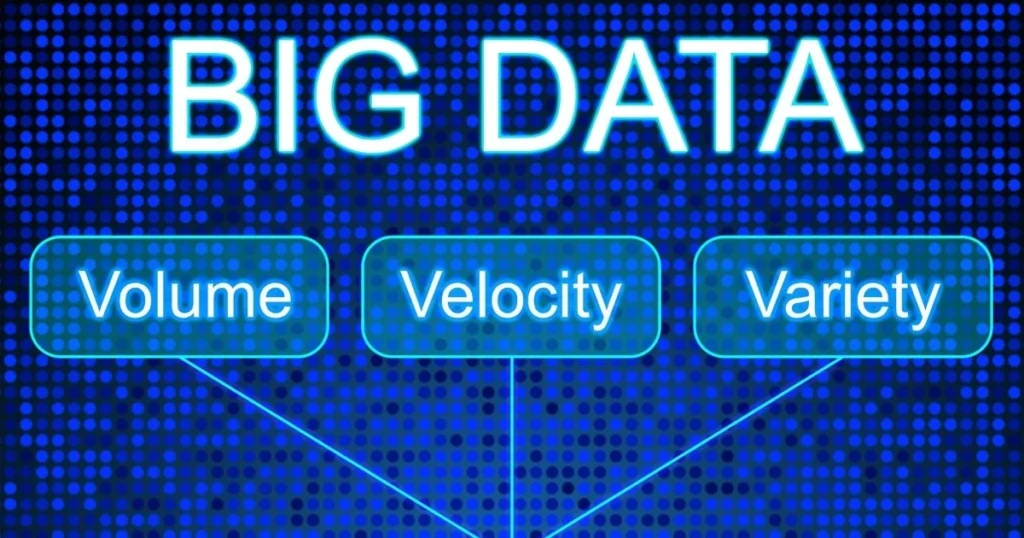
The three Vs of big data refer to Volume, Velocity, and Variety, key traits that define large-scale data challenges. Doug Laney first described these in 2001, and they remain central to how organisations manage information overload.
- Volume points to the sheer size of data generated daily from sources like social media, sensors, and transactions. For example, global data creation hit 181 zettabytes in 2025, far beyond what standard databases can store.
- Velocity covers the speed at which data streams in, often instantly. Think of stock market feeds or video streams that demand instant processing to stay relevant.
- Variety describes the mix of data types, from structured numbers in spreadsheets to unstructured text, images, and videos. This diversity makes analysis tricky but rich in insights.
Volume in the 3 Vs of Big Data
Volume stands out as the most visible of the three Vs of big data, representing enormous data quantities. Companies now deal with terabytes or petabytes, a leap from gigabytes in the past. This growth comes from IoT devices, online shopping, and mobile apps. A single airline flight generates 10 terabytes of sensor data, showing how volume scales quickly.
For example, consider this scenario: a single airline flight can produce 10 terabytes of sensor data from engines, weather conditions, and passenger systems, while global e-commerce giant Amazon handles over 2.5 quintillion bytes daily across its operations. In India, the data volume surge is even more striking, with projections showing the country generating 20 zettabytes annually by 2025 from digital payments, Aadhaar biometrics, and OTT streaming services. Sectors like healthcare see hospitals amassing petabytes from electronic records and imaging scans, vital for analysing patient cohorts for drug trials.
Handling volume requires distributed storage like Hadoop’s HDFS, which spreads data across clusters. Without such tools, processing becomes impossible, leading to lost opportunities.
Velocity Among the 3 Vs of Big Data
Velocity, the second V in the 3 Vs of big data, focuses on data speed. Data arrives fast, and delays can mean missed chances, like in fraud detection where seconds count. Examples include Twitter streams with millions of posts per minute or e-commerce sites tracking user clicks instantly. Spark excels here with its in-memory processing, performing up to 100 times faster than traditional disk-based methods like MapReduce in Hadoop for velocity-heavy workloads. Apache Kafka pairs well as a streaming platform, handling trillions of messages daily with sub-millisecond latency.
These tools enable near-real-time analytics, turning fast data into immediate actions like dynamic pricing in ride-sharing apps or live traffic rerouting.
“Velocity is not just about speed; it’s about making data actionable before it loses value,” notes a TechTarget analysis on big data traits.
For professionals eyeing big data analytics jobs, mastering velocity tools opens doors to high-demand roles in finance and telecom.
Variety: The Diverse Side of the 3 Vs of Big Data
Variety completes the 3 Vs of big data by highlighting data formats. Structured data fits neatly into tables, like customer IDs and sales figures in SQL databases; semi-structured data, such as JSON or XML files from APIs, adds flexibility with tagged elements; and unstructured data – emails, photos, videos, social posts, and audio – forms 80-90% of all data, defying simple rows and columns.
This mix actually can pose challenges for analysts, as no single tool handles every type efficiently. Hadoop processes batch variety well through its ability to store and index disparate formats across clusters, while Spark Streaming tackles live diverse feeds, blending real-time text streams with image metadata in one pipeline. NoSQL options like MongoDB shine for semi-structured JSON, and tools such as Elasticsearch index unstructured content for quick searches.

Big Data vs Traditional Data: Main Differences
Big data differs sharply from traditional data in scale and nature. Traditional data suits relational databases like SQL for small, structured sets updated slowly.
| Aspects | Big Data | Traditional Data |
| Volume | Petabytes+ | Gigabytes to terabytes |
| Velocity | Real-time streaming | Batch processing |
| Variety | Structured, unstructured, semi | Mostly structured |
| Tools | Hadoop, Spark | RDBMS like Oracle, MySQL |
| Analysis Speed | Near real-time | Periodic reports |
Big data vs traditional data shows why firms shift: traditional limits insights from modern sources. “Big data unlocks patterns traditional systems ignore,” as per GeeksforGeeks.
Moving to the 4 Vs of Big Data
Many extend the three Vs of big data to four, adding Veracity. Veracity addresses data quality and trustworthiness amid noise and biases.
The 4 Vs of big data include Volume, Velocity, Variety, and Veracity. Poor veracity, like faulty sensor readings, skews results, so cleaning pipelines are vital. Value sometimes joins as a fifth V, stressing usable insights. In the 4 Vs of big data, organisations focus on turning raw info into decisions.
Read About Veracity In Big Data in Detail Here
Role of Big Data in Data Science and Analytics
Big data fuels data science and analytics, providing the raw material. Data science builds models for predictions using machine learning on these datasets, while analytics draws business insights.
Hadoop stores vast volumes, Spark speeds velocity handling. “Big data is the fuel, data science the engine, analytics the dashboard,” sums up the ecosystem.
Career Opportunities 2026: Big Data Analytics Jobs
Big data analytics jobs boom in India, with over 2,000 openings on LinkedIn alone. Roles like data analysts earn well, projected to grow 45% by 2026.
- Demand skills: Hadoop, Spark, Python for the three Vs of big data.
- Salaries: Entry-level Rs 6-10 lakhs, seniors over Rs 20 lakhs.
- Sectors: IT, finance, e-commerce.
Learning Big Data: Courses and Classes in Bangalore
Bangalore leads in tech training, with big data classes in Bangalore covering the 3 Vs hands-on. Enrol in big data analytics courses to master tools.
Zenoffi E-Learning Labb offers data science courses in Bangalore and data analytics courses, including big data modules on Hadoop and Spark. Located in JP Nagar, they provide live classes, recordings, and placement support that can help you land big data analytics jobs. The data science course dives into the Vs of big data, with projects that can definitely help. Data analytics courses focus on insights from variety.
So, why Bangalore? Well, the proximity to firms like Infosys fuels big data analytics jobs!

On A Final Note…
The 3 Vs of big data – Volume, Velocity, and Variety – stand as the core traits that separate overwhelming data chaos from actionable intelligence in our data-driven era. These pillars not only highlight the gaps in big data vs traditional data approaches but also pave the way for advanced frameworks like the 4 Vs of big data, where Veracity ensures trustworthy outcomes.
For professionals and businesses in Bangalore and across India, grasping these concepts opens doors to thriving big data analytics jobs, where demand surges in sectors from e-commerce to healthcare.
Whether you seek big data classes in Bangalore or structured big data analytics courses, institutes like Zenoffi E-Learning Labb deliver hands-on training in data science courses in Bangalore and data analytics courses, complete with Hadoop, Spark projects, and placement support to kickstart your career.
FAQs
-
What exactly are the 3 Vs of big data?
Volume, Velocity, Variety define the three Vs of big data, handling size, speed, and types.
-
How does big data vs traditional data impact businesses?
Big data scales for real-time insights; traditional suits small sets.
-
What is the 4 Vs of big data?
Add Veracity to the 3 Vs for data reliability – Volume, Velocity, Variety and Veracity.
-
Where to find big data classes in Bangalore?
Zenoffi E-Learning Labb runs big data analytics courses and data science courses in Bangalore.
-
Are big data analytics jobs growing in India?
Yes, with thousands of openings and high salaries.