





Difference Between One-Way ANOVA And Two-Way ANOVA: Statistics is the language of data science, and one of its most fascinating chapters is ANOVA (Analysis of Variance). If you’ve ever wondered how researchers test whether multiple groups differ significantly, chances are you’ve bumped into ANOVA. But here comes the common question: What’s the difference between one-way ANOVA and two-way ANOVA?
At first glance, they sound almost the same, but in reality, they serve very different purposes.
And if you’re a budding data scientist, you’ll be excited to know that these topics are covered extensively in Zenoffi E-Learning Labb’s Advanced Diploma in Data Science and P.G. Diploma in Data Science & GEN AI. These are among the best data science courses in India, designed to prepare you for real-world problem solving.
So, let’s roll up our sleeves and dig deeper.
What is ANOVA?
Before comparing one-way ANOVA and two-way ANOVA, let’s first get the basics straight.
ANOVA (Analysis of Variance) is a statistical method used to test whether there are significant differences between the means of three or more groups. Instead of comparing groups pair by pair (like in t-tests), ANOVA handles them all at once.
To quote Ronald A. Fisher, the father of modern statistics:
“The statistician cannot evade the responsibility for understanding what the numbers do mean.”
That’s exactly what ANOVA does, it helps you understand whether the variation in your data comes from actual group differences or just random chance.
Learning About One-Way ANOVA
Now, let’s start with the simpler version, One-Way ANOVA.
What is One-Way ANOVA?
A one-way ANOVA is used when you want to compare the means of three or more groups based on a single factor (independent variable).
For instance:
- Do students from three different colleges score differently in mathematics?
- Does the average income vary across people working in IT, banking, and healthcare?
Here, the factor (college or profession) is only one, hence, one-way.

One-Way ANOVA Example
Imagine you’re testing whether three teaching methods affect student performance differently. You collect exam scores from students taught by each method and run a one-way ANOVA test. If the p-value is less than 0.05, you conclude that teaching methods significantly affect scores.
This is a classic one-way ANOVA example.
One-Way ANOVA Formula
The formula for one-way ANOVA revolves around comparing variance between groups and within groups:

This formula is the heart of every one-way ANOVA question.
One-Way ANOVA Table
The output is usually presented in a table like this:
| Source of Variation | Sum of Squares (SS) | Degrees of Freedom (df) | Mean Square (MS) | F-statistic |
| Between Groups | SSb | k-1 | MSb = SSb/(k-1) | MSb/MSw |
| Within Groups | SSw | N-k | MSw = SSw/(N-k) | |
| Total | SSt | N-1 |
This one-way ANOVA table helps in interpreting the results clearly.
Learning About Two-Way ANOVA
Now, let’s turn to the more complex sibling -Two-Way ANOVA.
What is Two-Way ANOVA?
A two-way ANOVA is used when you want to compare the means across groups while considering two factors (independent variables). It not only tells you about the individual effect of each factor but also whether there’s an interaction effect between them.
For example:
- Do exam scores vary by teaching method and gender?
- Does sales performance depend on advertising type and region?
Here, there are two factors, hence two-way.

Two-Way ANOVA Example
Suppose you want to check whether diet plans and exercise routines affect weight loss. You divide people into groups based on diet and exercise combinations, and then run a two-way ANOVA test.
This is a textbook two-way ANOVA example.
Two-Way ANOVA Formula
The formula breaks down into three parts:
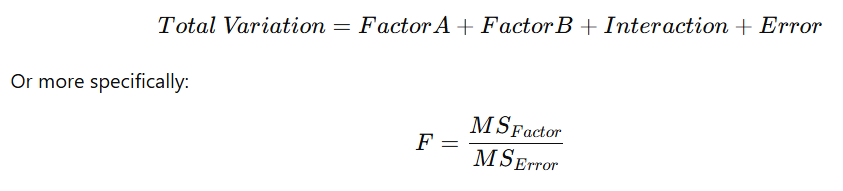
Each factor (A, B, and interaction) has its own F-ratio to be tested.
This is the backbone of every two-way ANOVA formula.
Two-Way ANOVA Table
Here’s how the results typically look:
| Source of Variation | Sum of Squares (SS) | Degrees of Freedom (df) | Mean Square (MS) | F-statistic |
| Factor A | SSA | a-1 | MSA | MSA/MSe |
| Factor B | SSB | b-1 | MSB | MSB/MSe |
| Interaction (A×B) | SSAB | (a-1)(b-1) | MSAB | MSAB/MSe |
| Error | SSE | ab(n-1) | MSe | |
| Total | SST | Nab-1 |
This two-way ANOVA table helps analyse not just main effects but also the interaction effect.
Difference Between One-Way ANOVA and Two-Way ANOVA
Now comes the heart of the blog: the difference between one-way ANOVA and two-way ANOVA.
| Features | One-Way ANOVA | Two-Way ANOVA |
| Factors (Independent Variables) | One factor | Two factors (plus interaction) |
| Example | Teaching method only | Teaching method and gender |
| Formula Focus | Variance between vs within groups | Variance due to Factor A, Factor B, Interaction |
| Table Output | Simple | More detailed with three F-ratios |
| Use Case | Basic group comparison | Complex analysis with interactions |
To put it simply:
- If you’re testing just one condition, use one-way.
- If two conditions matter, use two-way.
And that’s the fundamental difference between one-way ANOVA and two-way ANOVA.
Where Is ANOVA Used?
- Marketing: One-way ANOVA can test if customer satisfaction varies across different branches. Two-way ANOVA can check if satisfaction varies by branch and time of day.
- Healthcare: One-way ANOVA can compare recovery times across treatments. Two-way ANOVA can test treatment effectiveness across both age groups and genders.
- Education: One-way ANOVA might test different teaching strategies. Two-way ANOVA might add the variable of student background.
The applications are endless. And in the age of data-driven decision-making, mastering these concepts is a must.
Why You Should Learn This in Data Science?
So, you might ask, is data science a good career? Absolutely yes! According to NASSCOM, India will need over 11 million data science professionals by 2026.
To build a strong foundation, you need hands-on practice with tools like ANOVA, regression, clustering, and more. That’s where Zenoffi E-Learning Labb steps in. Their Advanced Diploma in Data Science and P.G. Diploma in Data Science & GEN AI are counted among the best data science courses in India.
By mastering concepts like the difference between one-way ANOVA and two-way ANOVA, you’ll be better equipped to tackle advanced topics in machine learning and AI.
On A Final Note…
We’ve walked through the difference between one-way ANOVA and two-way ANOVA with formulas, tables, and examples. Remember:
- One-way ANOVA is for one factor.
- Two-way ANOVA is for two factors plus interaction.
Both are indispensable tools in statistics and data science. And if you’re serious about building your career, it’s time to invest in structured learning. At Zenoffi E-Learning Labb, you’ll find some of the best data science courses that not only answer the question is data science a good career? but also set you on the right path with practical skills.
So, what’s stopping you from learning and upskilling?!
FAQs
Q1. Can you give a one-way ANOVA example?
Yes, testing whether different teaching methods lead to different student performance.
Q2. What is a two-way ANOVA calculator?
It’s an online tool/software that helps compute F-values for Factor A, Factor B, and their interaction without manual calculation.
Q3. How do I interpret a one-way ANOVA table?
Look at the F-statistic and p-value. If p < 0.05, the group means are significantly different.
Q4. Is data science a good career in India?
Yes, with growing demand in IT, healthcare, banking, and e-commerce, it’s one of the most sought-after fields.